
A new chapter begins
On 30 July 2025, the European Commission adopted Recommendation C(2025) 4984 final, inviting non-listed SMEs to use the Voluntary Sustainability Standard for SMEs (VSMe) to report in a voluntary and proportionate way. The Commission also asked large companies and financial intermediaries to limit their requests — as far as possible — to the data required by this framework, thereby reducing the “trickle-down” effect of questionnaires and non-standardised compliance burdens.
It is not a new obligation. Instead, it is a move that makes a common language operational and recognised across the EU, finally clarifying the rules of the game between suppliers and buyers. The VSMe, already designed as a simplified, modular, and free ESG framework for small and medium-sized enterprises, now becomes a concrete tool to make sustainability accessible and actionable even for those who have so far perceived it as a topic “for large companies only.”
In Italy, where 99.8% of all companies are SMEs and they generate more than 70% of private-sector employment (ISTAT), the potential impact is enormous. The VSMe is not a reduced version of the CSRD; it is purpose-built, with proportionate indicators, clear language, and the possibility to grow step by step. But its real value is measured outside official documents: in supply chains, in contracts, and in the everyday relationships between suppliers and clients.

Beyond Compliance: Real Business Impact of ESG Adoption
In the construction sector, both public and private tenders already reward suppliers that provide verifiable ESG data. These are not the only award criteria, but in some cases they make the difference between winning and losing. A 25-person renovation company, supplier to a major real estate group, saw a major contract slip away due to the lack of a formal emissions report. If it had already implemented a structured system for measuring and reporting sustainability, it would have been able to quickly provide a credible document and strengthen its overall offer.
In advanced manufacturing, an SME producing components for the furniture sector developed an R&D project for fully recyclable panels. Before launching the product, it chose to establish an ESG assessment and reporting pathway to measure its initial environmental and social performance. This technical foundation gave the company the tools to engage with clients and certifiers, build a credible narrative for investors, and avoid greenwashing risks by demonstrating transparency from the prototype stage.
In high-end hospitality, the ability to document one’s environmental and social impact has become an essential part of the value proposition for tour operators and international clients. A luxury relais in Umbria, lacking consolidated data, spent months responding to a Nordic operator’s requests regarding local sourcing, water consumption, and working conditions. A pre-established system for data collection and analysis would have reduced time and complexity, putting the hotel in a position to act proactively.
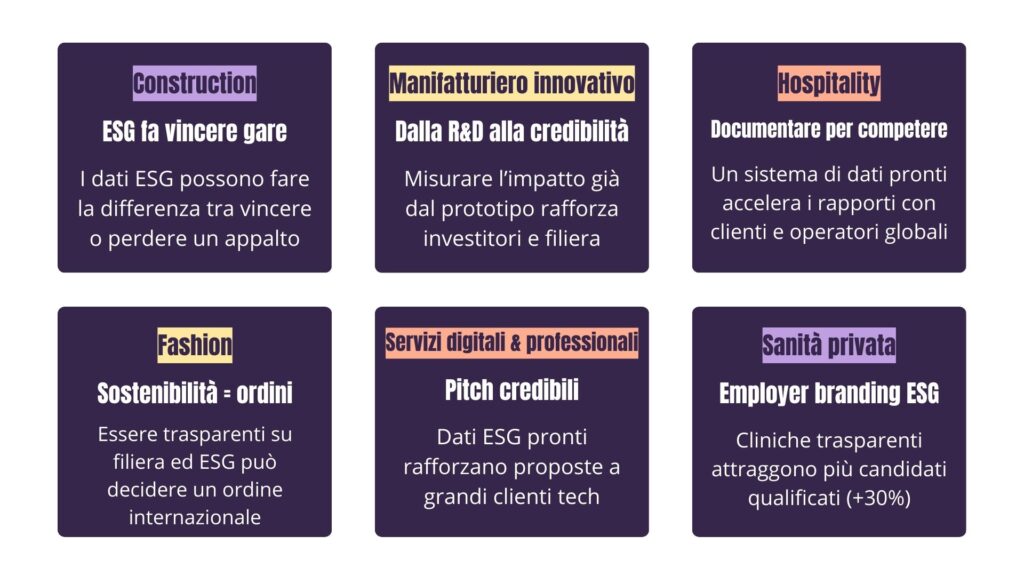
In the fashion sector, pressure comes from the supply chain: major brands ask suppliers to share key indicators on energy use, waste, gender equality, and pay transparency. A knitwear manufacturer in the Marche region lost an international order because it was not ready to provide complete and structured documentation. In contexts where quality and price are comparable, being able to demonstrate certified operational sustainability becomes an immediate differentiating factor.
On the other hand, a small artisanal leather accessories workshop integrated ESG measurement as the first step in a broader business revitalisation plan. In addition to improving the internal climate through a structured “listening” process (with a +20% retention increase), it gained credibility with international buyers who value supply-chain transparency, expanding its market reach.
In professional and digital services, sustainability has become one of the evaluation criteria in corporate contracts, alongside expertise and price. A creative agency struggled during a pitch with an international tech group because it did not have ready-to-use data to support its inclusion policies and responsible IT supply-chain management. It was just one factor among many, but it was enough to influence the final decision.
In private healthcare, a network of specialist clinics chose to integrate ESG reporting into an employer branding strategy designed to attract qualified doctors and nurses. It measured and documented continuous training, safety, employee well-being, and the environmental impact of its facilities. This transparent approach strengthened its positioning as an “employer of choice” and led to a 30% increase in unsolicited applications from highly specialised professionals.
Across all these sectors, it is not a single standard that makes the difference. What matters is embedding a structured sustainability pathway — with measurement and reporting — into a larger mosaic made of commercial relationships, sales strategy, competitive pricing, reputation, and execution capability.
It is one of the key pieces of the equation and, when solid, it can unlock concrete advantages: from access to financing and preferential terms, to the ability to attract and retain talent, and even to a stronger sense of employee engagement.
When products or services are comparable, this journey can become the factor that tips the balance: opening doors in negotiations, strengthening credibility, and responding quickly to increasingly frequent requests from procurement teams and stakeholders.
And above all, it allows companies to build a brand narrative that goes beyond what they sell and speaks to values, impact, and vision — in a market where every detail matters and missed opportunities rarely come back.
Four reasons why SMEs can no longer postpone
For years, many SMEs have seen ESG reporting as an excessive burden. But the numbers tell a different story:
- +20% average revenue growth for Italian SMEs that integrate sustainability practices into their core processes (SDA Bocconi, 2024).
- ESG-oriented companies have a 30% higher customer retention rate and stronger margins (Global Compact Network Italia).
- 36% of B2B companies would switch supplier if ESG criteria were not met — a figure expected to rise to 57% within the next three years (Bain & Company).

These trends translate into four concrete advantages for those who take action now, as seen in the business stories above and confirmed by the Global Compact Network Italia:
- Market access – Large companies increasingly require ESG data from suppliers as an entry condition.
- Financing and grants – Banks and investment funds offer better terms to companies that demonstrate a structured commitment.
- Innovation and competitiveness – Sustainability becomes a lever for more efficient processes and higher-value products.
- Attraction and retention of talent – 64% of young people refuse job offers from companies without solid ESG policies (Forbes, 2024).
Yet behind the rhetoric that “sustainability is for everyone,” many SMEs have encountered three recurring obstacles:
- Complexity – Standards designed for multinationals, with overly detailed indicators.
- Costs and time – Long processes, hard-to-find data, and hours taken away from core business activities.
- Distance from the real market – Difficulty in seeing immediate and measurable returns.
This is where the current voluntary European standard for SMEs comes into play: it’s not a solution to everything, but an accelerator that lowers entry barriers thanks to clear language, targeted indicators, and a modular structure. To create real value, however, it must be embedded in a broader process that brings together:
- Technology to speed up and structure data collection.
- Strategic consulting to turn numbers into competitive advantages.
- Authentic storytelling to communicate your commitment without slipping into greenwashing.

“30 days to grow”: technology and consulting, integrated from day one
For many SMEs, the real obstacle isn’t the awareness that sustainability matters — but understanding how to take concrete, rapid action. What they need are tools that allow them to measure, report, and give strategic meaning to data from day one.
“30 days to grow” was created precisely to meet this need — a program developed by Innovamey together with Treeblock: technology and consulting working in parallel, because one without the other simply doesn’t work.
With Treeblock One, Treeblock’s platform, ESG measurement becomes accessible and fast: in just a few days, a company can collect, validate, and organize its data, visualize it through clear charts and indicators, and generate a structured document ready for clients, stakeholders, and investors.
But technology is never “on its own”: from the very first access to the platform, Innovamey’s consultants guide the reading of the questions, the definition of data sources, the consistency of the information, and the interpretation of the results. This ensures that the final document is not only accurate and verifiable, but already designed to become a commercial, reputational, and organizational asset.
During the program:
- measurement and interpretation happen together, avoiding the separation between “the numbers moment” and “the strategy moment”;
- the data is adapted to different audiences (investors, B2B clients, employees, media) as the report is being built;
- concrete actions, priorities, and opportunities emerge immediately, with no downtime between data collection and strategic use of the information.
With several SMEs, we have already activated the VSME standard, completing ESG measurement and analysis with Treeblock One and Innovamey in days, not months. In some cases, the data — already interpreted with a commercial lens during the process — became the foundation for new commercial proposals and initiatives by our clients.
A sustainability report — even in a simplified form — is not a PDF to be archived: it is a business map that helps identify supply-chain risks and opportunities, plan investments, and engage employees and stakeholders. A textile SME in Prato, for example, discovered through its first ESG assessment that 80% of its environmental impact occurred during the dyeing phase: it invested in low-water-consumption processes, reduced costs by 15%, and secured two new international clients.
Different stakeholders, different meanings: the risk of falling behind
For an investor, a VSME report is a signal of risk management and long-term vision.
For a corporate client, it is proof of supply-chain reliability.
For an employee, it shows that the company cares about its social and environmental impact.
For a local community, it is a pact of transparency.
The same page of a report can mean different things — which is why a Tech + Strategy approach becomes a concrete, valuable, and smart activation.
And those who don’t adopt minimum standards risk:
- exclusion from the supply chain in sectors such as fashion, agri-food, construction, and tourism;
- loss of reputation: 40% of consumers abandon a brand if they discover it is not sustainable (McKinsey)
- greater vulnerability: without mapping ESG risks, it becomes harder to respond to environmental, regulatory, or reputational crises.

Why start now, not “when it becomes mandatory”
The VSME is voluntary. But the history of European regulations shows that what is a recommendation today becomes a requirement tomorrow.
Starting now means:
- avoiding last-minute rushes when reporting becomes a contractual requirement;
- building credibility within the supply chain, gaining an advantage over those who haven’t started yet;
- learning to use ESG data as a strategic lever, not just as a response to an obligation.
Innovamey and Treeblock are already applying the VSME with clients across different sectors, taking advantage of this moment in time when it’s still possible to do things well and a head of the curve.
The VSME is not just a regulatory simplification: it’s a springboard.
Conclusione
Non è questione di se, ma di quando lo userete. La sostenibilità è ormai il nuovo linguaggio del business europeo: chi lo parla oggi, domani sarà irraggiungibile.
With the VSME Recommendation of July 30, 2025, across all sectors, the difference is not made by a single standard but by having an active sustainability pathway that is measured, reported, and integrated into the company’s strategy and reputation.
Without this piece in place, companies risk being excluded from funding, preferential conditions, tenders, and partnerships.
When offers are otherwise equal, it can be the factor that closes a deal or makes it fall through: it opens doors, strengthens credibility, and meets the increasingly pressing demands of procurement, the market, and stakeholders.
And above all, it defines a brand narrative that goes beyond the product, speaks to values and impact, and positions the company in a place that competitors without this asset cannot reach.
With the European voluntary standard for SMEs, companies today have a real opportunity to start in a simple and structured way.
With Innovamey + Treeblock and the “30 Days to Grow” program, technology and consulting work together from day one to transform sustainability from a future obligation into an immediate, measurable, and market-ready advantage.
The moment to start is now.
Are you ready?
Innovamey is the organisation that turns sustainability into a real engine of growth, supporting companies in designing sustainable strategies, transforming business models, and communicating with impact.
We innovate products and services by placing sustainability at the center, developing solutions that combine progress, responsibility, and competitiveness. We don’t just imagine the future — we build it.
We collaborate with prestigious academic institutions such as Bocconi University, Università Cattolica, and the Glion Institute of Higher Education, training the leaders of tomorrow and developing innovative business strategies through real-world cases and direct engagement with the new generations.
For us, sustainability is not just a goal — it is an evolutionary process, a dynamic balance between innovation, responsibility, and long-term value creation.
We have supported major organisations in rethinking their processes through the lens of positive impact and business-driven results — from evolving products and services for a market increasingly attentive to sustainability, to creating operations designed to attract and empower talent who understand the importance of people, the planet, and profitability.
We help organisations build a sustainable culture through training and conscious leadership, supporting them in authentically communicating their transformation, so that sustainability becomes not just an objective, but a lived and shared reality.
We have played a leading role in major events such as IKN’s Climate Tech, Team Different’s Ethical HR, and Il Sole 24 Ore’s Global Inclusion, contributing to the development of strategies that combine economic progress with social and environmental responsibility.
Innovamey stands for action, impact, and transformation: we work with companies to build a future in which sustainability means innovation, value, and conscious growth.
Because change isn’t something you talk about. You make it happen.