
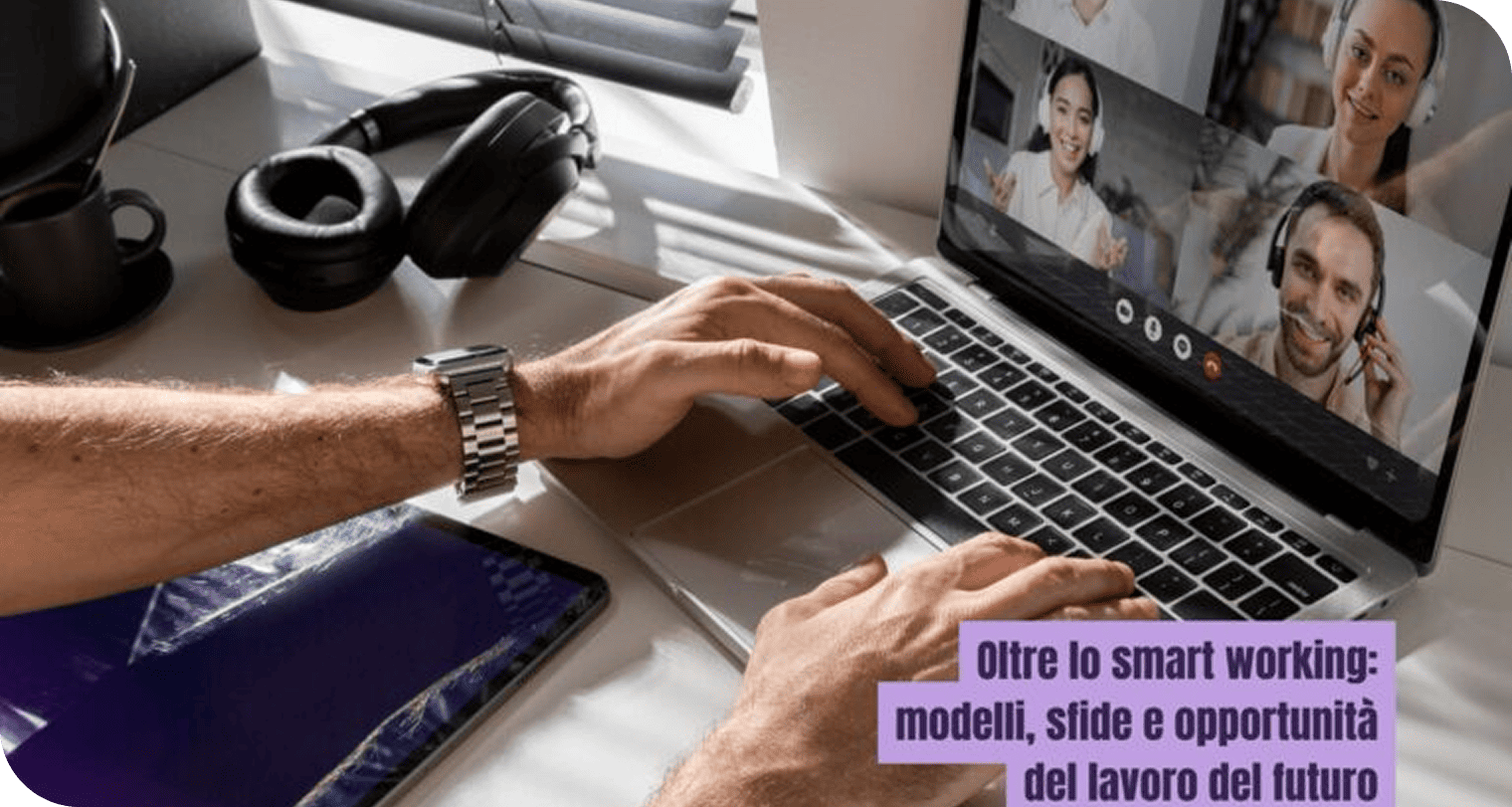
August 2025: Work Reinvents Itself
In the 1970s, the idea of working from home was unthinkable: the office was the only place considered acceptable for carrying out professional activities. It was only with the advent of the internet and high-speed connections that the concept of flexible work gradually became plausible. However, it was Covid-19 in 2020 that triggered a rapid and radical transformation: workers around the world experienced remote working, proving that a multiplicity of workplaces does not mean a loss of productivity.

Global, European, and Italian Overview
In 2020, according to data from the International Labour Organization, more than 40% of workers in high-income countries worked entirely remotely for at least a significant period. In the following years, fully remote work began to decline, while the hybrid model gained ground as a more balanced and sustainable approach.
In Europe, Eurofound reports a decline in fully remote workers — from 24% in 2022 to 14% in 2024 — while today 44% of European workers operate in a hybrid model.
In Italy, the Politecnico di Milano’s Observatory estimates around 3.55 million smart workers in 2024, with a projected 5% increase in 2025, reaching 3.75 million. Large companies are driving the change: 96% have adopted structured policies, and nearly 2 million employees alternate between home and office. In the public sector, around 500,000 people work in agile mode, and some administrations are planning to increase this number. SMEs account for around 520,000 smart workers, with no signs of expansion.
Beyond Smart Working: The New Frontiers of Work
The 2025 landscape goes beyond traditional smart working, introducing a set of innovative work models designed to balance productivity and well-being:
- Workation: combines work with staying in tourist destinations such as seaside villages, mountain refuges, or art cities. In Italy, cities like Genoa, Catania, Florence, Bari, and Palermo are among the most popular destinations for digital nomads. In Tuscany, places like Santa Fiora or Montepulciano offer equipped workspaces, discounts, and coworking areas.
- Four-day week: reducing the workweek to four days with no change in salary is already being tested in Italian companies such as EssilorLuxottica (with over 15,000 employees involved), Intesa Sanpaolo, Mondelez, and others. In the public sector as well, projects are underway for 36 hours over four days, with voluntary participation and regulatory support.
- Flexitime: working hours can be fully personalised within the workday, as long as goals are met and minimum coverage is ensured during key contact times.
- Job Sharing: two professionals share a role and its responsibilities, with differentiated, interchangeable working hours. A model that supports balance without giving up operational roles.
- Structured digital nomadism: some companies allow employees to work from another country for several months, supporting them with fiscal, legal, and organisational aspects. In Italy, the Digital Nomad Visa has been active since April 4, 2024, for highly qualified non-EU workers, requiring a minimum income of around €28,000 per year, health insurance, and previous remote-work experience. Several hubs in Sardinia and Puglia are attracting nomads through dedicated programmes.
- Quality gig economy: well-paid micro-projects based on specific expertise — an evolution of the traditional gig-based work model.
- Hub & Spoke: a central office supported by satellite locations or peripheral coworking spaces, designed to reduce commuting while maintaining real, tangible connections with the company.
- Async-first: communication is predominantly asynchronous (documents, messages, videos), with fewer real-time meetings — ideal for distributed teams or those working across different time zones.
- Blended work: a model in which artificial intelligence collaborates with people on tasks such as analysis, writing, and automation; work shifts toward more strategic and creative activities, freeing up time and resources.
All these models share one principle: making work adaptable to people — not the other way around.

Flexibility: A Criterion for Choice
Le ricerche 2024‑2025 mostrano che oltre il 70% degli smart worker italiani non accetterebbe un lavoro esclusivamente in presenza e molti valuterebbero il cambio di impiego o chiederebbero un aumento significativo per rinunciarvi. Per quasi il 50% dei lavoratori, la flessibilità conta più di uno stipendio più alto.
Five exemplary companies that are reinventing how and where we work
- TeamSystem (Italy): through the TeamSystem Next initiative, it offers up to 80% smart working and the possibility to independently choose a four-day week in the form of a “Light Friday.”
- Intesa Sanpaolo (Italy): the first major Italian banking group to experiment with the four-day week on a voluntary basis, with 36 hours over 4 days and up to 120 days of smart working per year. A meal-voucher allowance is also provided for employees working remotely.
- EssilorLuxottica (Italy): has introduced a four-day week for around 15,000–20,000 employees, offering 20 Fridays off per year with no reduction in salary. The plan aims to improve well-being, efficiency, and inclusion.
- Bee / Growens (Italy–Europe): a Southworking company with its main headquarters abroad. 56% of its Italian workforce works from small towns in Southern Italy, supporting local development and distributed talent. It has also established the Cagliari Innovation Lab to invest in territorial innovation.
- Grenke (Italy, European multinational): adopts a hub-and-spoke model integrated with local coworking spaces, smart working supported by a sustainable ergonomic kit, and mandatory in-office presence once a week. This approach has led to increased productivity, satisfaction, and employee retention.
YOTTAWORLD: flexibility as a corporate culture
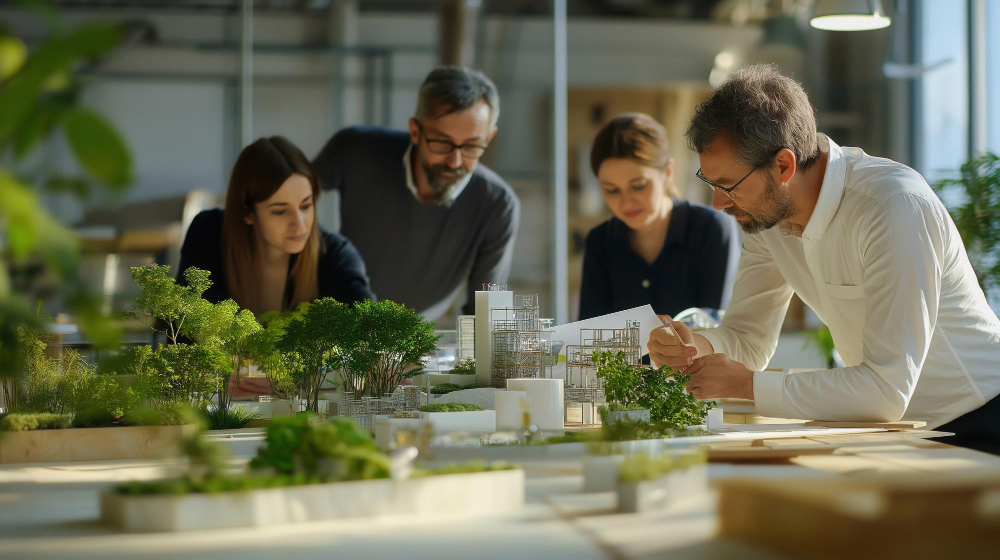
Among the virtuous examples in Italy, YOTTAWORLD stands out for an approach to flexibility that goes beyond a simple internal policy. The company — which Innovamey has supported through a Business Innovation journey driven by sustainability, views flexible work not as an additional benefit, but as an integral part of its organisational culture.
As Giulia Scanu, HR Manager at YOTTAWORLD, explains:
“Through our work with Innovamey, we realised that for us, flexibility has never been just a policy, it’s a human approach already rooted in our culture. It means trusting people, giving them autonomy and, at the same time, creating opportunities for real connection.”
La flessibilità ci ha portato benefici concreti in termini di benessere, coinvolgimento e soddisfazione del team. Per mantenere e rafforzare questa coesione, c’è anche il ‘FridaYotta’, il nostro appuntamento mensile ormai consolidato, pensato per aggiornarci sui progetti aziendali e trascorrere insieme un momento di convivialità che va oltre la sfera lavorativa.
“The main challenge remains balancing autonomy with organisational alignment: communication plays a crucial role here, and instant messaging channels along with spaces for continuous dialogue help us keep connection and transparency alive.”
This model shows how organisational innovation can go hand in hand with the human dimension, keeping engagement high even in distributed work environments.
How We Experience Innovamey: Structured Summer Flexibility
At Innovamey, work follows a hybrid model that values both in-person collaboration and focused remote work. Throughout the year, three days a week are spent in the office to encourage direct exchanges and brainstorming, while two days are dedicated to working from home for individual tasks and a more autonomous management of time.
In the summer months, those who wish can work from different locations: Sara chooses Sardinia, Sharon alternates between the sea and the mountains, Aram divides his time between Sicily and Milan, and Marija spends time with her family in Montenegro.

As Sharon says, “smart working gives us precious hours for training, passions, and family, but our days in the office keep human interaction alive.”
Sara highlights how “being in the office generates ideas and connections, while remote days allow for better management of private life.”
For Aram, founder of Innovamey, “the quiet of the home office is perfect for focusing, but in-person meetings are irreplaceable for creativity and team spirit.”
And as Marija says, “This freedom isn’t just a benefit — it’s a form of respect for our real lives.”
Designing the Future of Work: Strategy and Sustainable Growth
From the strictly in-office work of the 1970s to the flexible, diverse, and option-rich landscape of 2025, the transformation is complete. In Europe and in Italy, the hybrid model is now well established, but the future is already taking shape through new approaches: workation, the four-day week, structured nomadism, async-first models, and AI-enabled blended work. Today, the real challenge for companies is no longer adopting smart working, but designing work models that truly respond to people’s needs, offering self-regulation, autonomy, and well-being.
As of August 2025, people choose where, how, and when they work. Innovamey shows that work can be both flexible and deeply engaging at the same time.
Innovamey is the organisation that turns sustainability into a real engine of growth, supporting companies in designing sustainable strategies, transforming business models, and communicating with impact.
We innovate products and services by placing sustainability at the center, developing solutions that combine progress, responsibility, and competitiveness. We don’t just imagine the future — we build it.
We collaborate with prestigious academic institutions such as Bocconi University, Università Cattolica, and the Glion Institute of Higher Education, training the leaders of tomorrow and developing innovative business strategies through real-world cases and direct engagement with the new generations.
For us, sustainability is not just a goal — it is an evolutionary process, a dynamic balance between innovation, responsibility, and long-term value creation.
We have supported major organisations in rethinking their processes through the lens of positive impact and business-driven results — from evolving products and services for a market increasingly attentive to sustainability, to creating operations designed to attract and empower talent who understand the importance of people, the planet, and profitability.
We help organisations build a sustainable culture through training and conscious leadership, supporting them in authentically communicating their transformation, so that sustainability becomes not just an objective, but a lived and shared reality.
We have played a leading role in major events such as IKN’s Climate Tech, Team Different’s Ethical HR, and Il Sole 24 Ore’s Global Inclusion, contributing to the development of strategies that combine economic progress with social and environmental responsibility.
Innovamey stands for action, impact, and transformation: we work with companies to build a future in which sustainability means innovation, value, and conscious growth.
Because change isn’t something you talk about. You make it happen.